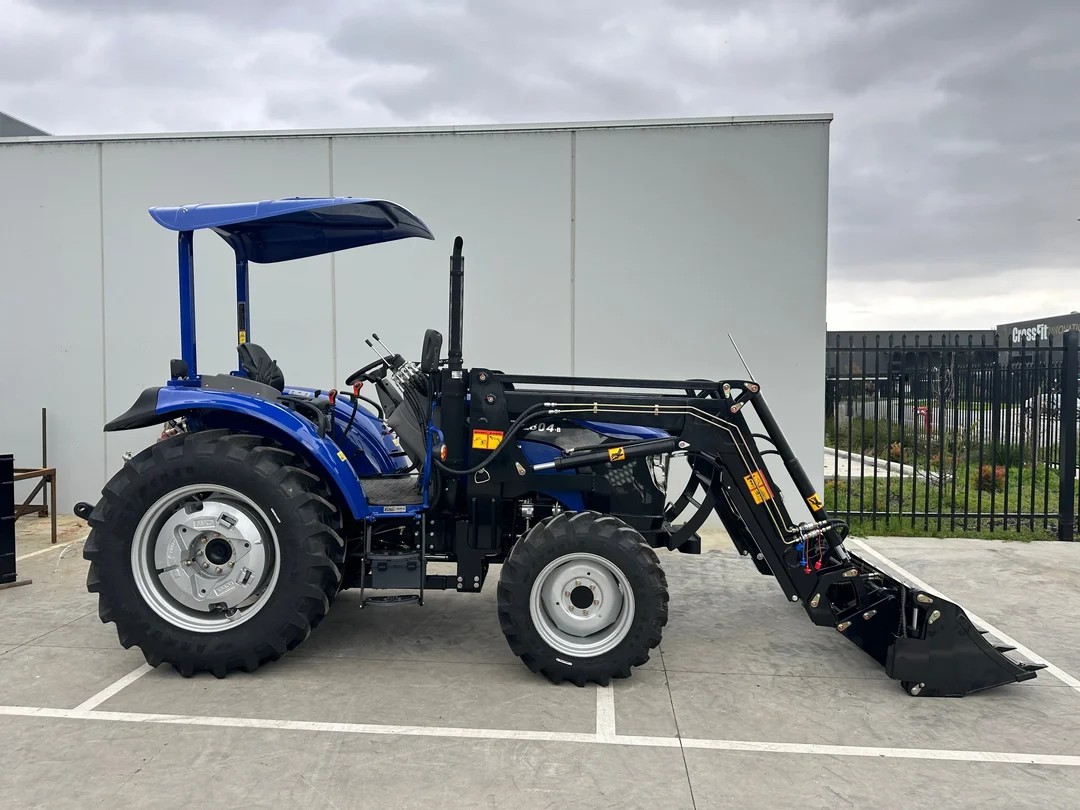
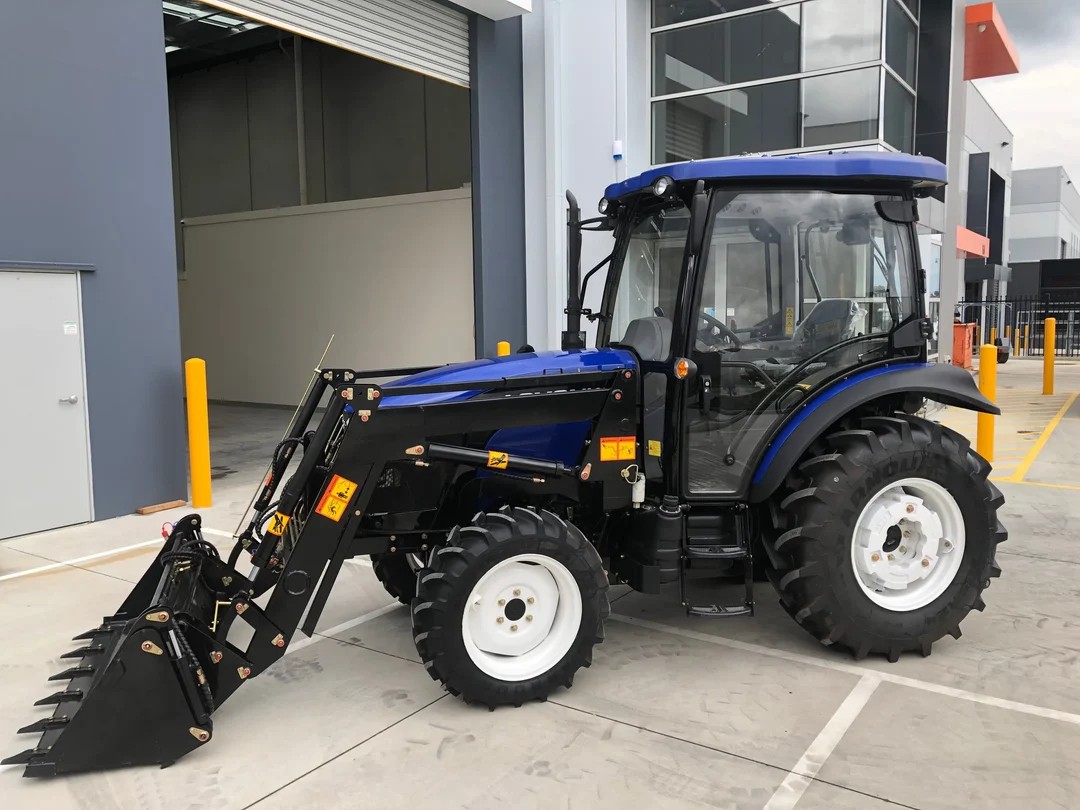
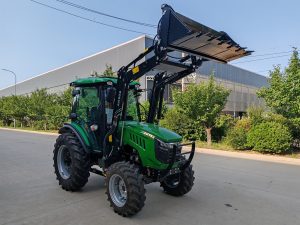
The front end loader is the one implement that turns a tractor from a mower into a genuine work vehicle. Scooping, carrying, loading, stacking, unstacking, cleaning out sheds, lifting pallets, feeding out hay, digging a bit when you have to. If you’re only ever going to buy one attachment with a tractor, this is almost always the one. The catch is that loader specs are where buyers get caught out more than anywhere else on a tractor spec sheet, because the numbers printed on the brochure don’t always describe the same thing, and some of them describe something the loader can’t actually do in the real world. This guide walks through what to actually look at, how bucket and attachment choices change the maths, and the compatibility question that costs people the most money when they get it wrong.
Three numbers that matter more than the rest
A front end loader spec sheet lists a dozen measurements. Most of them are informational. Three of them decide whether the loader will do what you want.
Lift capacity
This is the weight the loader can lift to full height at the pivot pin. On its own, it’s useful. The number you actually care about, though, is the lift capacity at the bucket edge, which is usually 30 to 40 percent lower because the leverage changes once the load sits out in front of the pivot. If a spec sheet shows a lift capacity without telling you where it was measured, the number is almost always the pivot pin figure. Ask for the bucket edge number before you decide.
Lift height
The height from the ground to the pivot pin at full raise. This decides whether the loader can stack hay into a shed, load a tipper truck, or get a bucket of feed into a bulk bin. A 2.5m lift height clears a standard 6×4 trailer. 3m clears a tipper. 3.3m or more is what you want if you’re loading into a truck bed regularly. Below 2.5m and the loader is really a ground level tool, which is fine for a lot of jobs but worth knowing before you buy.
Reach at full height
The horizontal distance from the front of the tractor to the pivot at full lift. This is what lets you drop a load into the middle of a trailer bed instead of just over the side rail. Not something anyone thinks about until the first time they try to tip into a tipper and find the loader can’t reach past the near edge.
Bucket options and what each one is really for
The bucket on the end of the loader isn’t a one size fits all part. Most AgKing loaders ship with a 4 in 1 bucket as standard, because it covers the widest range of jobs with a single attachment, but there are three bucket families worth knowing about.
General purpose bucket
The plain scoop. A single curved shell with a cutting edge along the bottom. Best for loose material: feed, mulch, sand, gravel, light soil. Cheap, strong, almost nothing to go wrong. The limitation is that it can’t grip anything. Any material that doesn’t scoop neatly is a job for a different bucket.
4 in 1 bucket
A general purpose bucket with a hydraulically operated front clamshell that opens and closes. This single attachment does four separate jobs. Scoop like a normal bucket. Dozer blade with the clam closed and locked. Grab with the clam closed around a load like timber or a bale. Levelling the ground by back dragging with the clam partially open. This is the bucket to pair with a loader if you only want to buy one, and it’s why AgKing specifies the 4 in 1 bucket across the AK range of tractors with front end loaders.
Rock or stone bucket
Slotted or tined so soil and fines fall through while rocks, roots and rubble stay in. For cleaning up a paddock, a creek bed or a building site, it’s faster than any other attachment because it doesn’t carry dead weight. It won’t handle loose material though, so it’s a second bucket rather than a replacement for a general purpose or 4 in 1.
Attachments that use the loader instead of the bucket
Most loaders in the AgKing range run a Euro quick hitch, which lets you drop the bucket and fit a different attachment in under a minute. The common ones:
- Pallet forks turn the loader into a forklift for shifting pallets, feed bags, poly tanks or anything else that arrives on a pallet. Capacity is usually similar to the loader’s own lift rating, and the limiting factor on pallet lift height is the loader’s reach rather than its lift height.
- Bale grab uses hydraulic rams to apply a firm but gentle grip on a round bale, which matters for silage bales where the wrap tears easily. Faster than a spear for shifting bales short distances and the only sensible choice for wrapped silage.
- Bale or hay spear takes a single round or square bale on a central tine and drives it where it needs to go. Cheaper than a bale grab and fine for everyday hay handling, but it punches a hole in the bale, which matters if you’re selling or storing them for long periods.
- Carry all is a flat deck or contained tray that bolts to the loader and gives you a contained space to haul tools, star pickets, posts or feed around the property without hooking up a trailer.
- Log grab uses a hydraulic jaw to hold fallen timber for cleanup after a storm, dragging to a cutting area or loading onto a trailer.
The useful part of the Euro hitch is that it makes buying attachments later on a straightforward exercise. You don’t need to go back to the original dealer for every piece. Any Euro hitch attachment fits.

Safe working load versus maximum lift load
This is the single most important thing to understand about front end loaders, and it’s where AgKing takes a clearer position than a lot of the market. Every loader has a maximum lift load, which is the heaviest thing it can physically lift in the right conditions. Every loader also has a safe working load, which is the weight it can lift repeatedly, day after day, without damaging the tractor over time. Those two numbers are not the same, and the gap between them is significant.
The common failure mode isn’t the loader itself. It’s the tractor’s front axle, which wasn’t designed to sit under a loader at maximum lift for hours a day. Overloading doesn’t usually show up as an immediate break. It shows up as early bearing wear, bent axle housings, cracked castings, and a tractor that starts tracking oddly after a few years of hard use. By the time the damage is visible, the warranty does not cover overloading of axles for loader work.
AgKing publishes safe working loads for its loaders and recommends operators stay inside them rather than chasing the headline lift figure. The safe working loads post goes into the detail of what each AK loader is rated at and why fitting heavier rams or added wheel weights to squeeze out more lift is a decision that ends in axle damage. It’s worth a read before you make a buying decision based on the biggest number on a brochure.
Matching the loader to the right tractor
The loader and the tractor are sold together as a matched pair, and that matching matters in ways that aren’t obvious until something goes wrong. The two to watch for:
Horsepower to drive line matching
It has been brought to AgKing’s attention that another dealer is selling a 90HP engine fitted into a 70HP drive line. On paper it looks like a bigger tractor for less money. In practice it’s a tractor with a transmission, front axle and driveshafts that weren’t designed for the torque of the engine sitting above them. AgKing specifies 90HP engines in a 90HP drive line and recommends buyers check the weight of the tractor and the loader specifications together rather than relying on the engine badge alone. If you’re comparing loaders between dealers, ask for the tractor’s operating weight and the loader’s lift capacity in the same quote. A loader rated to 600kg on a 2,400kg tractor behaves very differently to the same loader on a 4,600kg tractor.
Hydraulic flow rate
The loader is powered by the tractor’s hydraulic pump. A pump with low flow lifts and tilts slowly, which is annoying on a small job and genuinely limiting on a big one. Most of the AgKing tractors run a dedicated hydraulic pump plate on the loader circuit, which keeps cycle times reasonable even under load. If you’re looking at a loader on a non AgKing tractor, the flow rate in litres per minute is the number to compare, not the pump pressure.
Ballast and counterweight
A loader lifts a load off the front of the tractor, which unloads the rear wheels. Without ballast on the back, the rear tyres lose grip and the tractor wants to pivot forward. Rear wheel weights, a filled drag harrow on the 3 point linkage, or a counterweight box all do the same job. For regular loader work, factor in the cost of ballast when you’re budgeting.
What buyers get wrong
The mistakes people make with loader purchases are consistent enough to be worth naming.
Picking the loader before the tractor. The loader is a function of the tractor, not the other way around. The tractor’s front axle, hydraulic flow, weight and HP all set the limit on what loader will actually work. Buy the tractor for the job, then confirm the matched loader covers your lift and reach requirements.
Confusing lift at pivot with lift at bucket edge. Already covered above, but the single biggest cause of disappointment after delivery. Always ask where the quoted lift capacity was measured.
Buying for the one off job instead of the regular one. A loader that just barely handles your biggest occasional lift is a loader that will be overloaded for every regular job. Spec for the daily work, not the once a year lift.
Overlooking the bucket. A general purpose bucket is a cheaper line item, but if 70 percent of your jobs are bale handling, levelling and the odd dig, a 4 in 1 bucket pays for itself in the first few months.
The broader list of buyer mistakes, loader included, is covered in the tractor buying mistakes post, which is worth reading before a first purchase.
Matching to your jobs rather than the brochure
The loader section of the implements guide walks through which jobs the loader and its attachments cover. If you tell the AgKing team what you’re planning to lift, carry and load, and how often, they’ll work backwards from the job to the right tractor and loader combination rather than selling you the biggest number on the price list. It’s the more honest conversation, and it tends to end with a package that fits the work rather than one that disappoints inside the first season.
Frequently asked questions
Q. Can I add a front end loader to a tractor later?
Yes, but it costs more than buying the loader with the tractor from the start. Fitting a loader later involves mounting brackets, hydraulic plumbing, and sometimes adding hydraulic remotes or a dedicated pump. The AgKing team can retrofit a loader to most tractors in the AK range, and the work is cleaner if the tractor is already spec’d for it. If you think you’ll want a loader at any point, buying one with the tractor is always the cheaper route.
Q. What loader size do I need for round hay bales?
Round bales in Australia typically weigh between 300kg for small hay rounds and 700kg for larger or wetter bales. Silage bales can push past 800kg. The loader needs a safe working load above the bale weight, measured at the bucket or attachment edge rather than at the pivot. For most hobby farm hay work, a loader with a 600kg safe working load at the bucket edge covers it. For silage or commercial hay, aim for 800kg and above.
Q. How long does a front end loader last?
A loader on a well matched tractor, used inside its safe working load, can last the full working life of the tractor. The wear items are the bushes, pins and hydraulic seals, which are all serviceable. The things that end loader life prematurely are chronic overloading, unlubricated pivots, and corrosion where water sits in bracketry. None of those are failures of the loader itself, they’re ownership choices that catch up.
Q. Do I need a 4 in 1 bucket or will a general purpose do?
If you’re mainly moving loose material like feed, mulch or gravel, a general purpose bucket covers the work at a lower price. If you’re grabbing bales, dozing dirt, back dragging to level, or doing any job where opening and closing the bucket helps, the 4 in 1 pays back the extra within a few months. Most AgKing tractor packages include the 4 in 1 as standard for this reason.
Q. What’s a Euro quick hitch and why does it matter?
The Euro quick hitch is a standardised mounting system on the loader arms that lets you swap between a bucket, forks, a bale grab or any other attachment in under a minute without tools. It matters because it means you aren’t locked into buying attachments from the original dealer, and you can swap tools mid job without parking up for a workshop visit.